
Quick Summary
Addressing mold in your heating and cooling system requires immediate action to protect your home's air quality, as spores can begin growing on damp surfaces within 24 to 48 hours. While specialized remediation is necessary for active mold, Meridian Air Duct Cleaning Service acts as the essential partner for preventing regrowth and restoring indoor air quality through thorough mechanical duct cleaning and system maintenance. Homeowners can call (833) 637-3677 to schedule a free, no-obligation ductwork inspection and estimate to ensure their ventilation system is clean, clear of debris, and protected against the Pacific Northwest's unique moisture traps.
HVAC Mold Removal – Breathe Clean Air in Your Home Today
If you suspect a musty odor in your vents, professional HVAC mold removal services can safely restore your home’s air quality. While an emergency inspection and system shutdown can be initiated within 24 hours, a full remediation typically takes 2 to 5 days. Whole-system HVAC mold remediation typically costs between $3,000 and $10,000 depending on your system’s size, though basic duct cleaning without mold remediation may only cost $400 to $1,000. Depending on the extent of the contamination, HVAC remediation costs can also range from $2,000 to $6,000 according to other industry sources. Think of your ductwork like the lungs of your home: when dust and moisture settle inside, they create a damp blanket where spores thrive, quietly circulating contaminants every time the fan kicks on. While national cleaning chains often rely on superficial vacuuming that merely skims the surface, Meridian Air Duct Cleaning Service Vancouver uses a specialized rotating brush tool as part of mechanical debris removal, establishing Meridian Air Duct Cleaning Service Vancouver as a leader in thorough system hygiene. However, true mold remediation requires negative pressure containment, HEPA filtration, and EPA-registered treatments on hard surfaces only.
According to FilterKing citing the 2023 American Housing Survey, about 3% of households reported seeing mold, a number that rises quickly in humid environments. While Pacific Northwest humidity is a major factor, mold growth in HVAC systems occurs in any region with high humidity or moisture intrusion, as the U.S. EPA notes that mold can grow on damp surfaces within 24-48 hours. True remediation requires a thorough, mechanical clean to prevent regrowth. Our fully licensed and insured professionals protect your living space during every step of the process. You can schedule a free, no-obligation ductwork inspection and estimate to ensure your ventilation system is clean and clear of debris, with same-day service available for urgent air quality concerns.[1]
1. Urgent HVAC Mold Removal: Cost, Speed, and What to Expect
Addressing mold in your heating and cooling system requires immediate action to protect your home’s air quality. According to FilterKing citing the 2023 American Housing Survey, 3% of households reported mold. Because mold begins growing on damp surfaces within 24 to 48 hours according to the U.S. EPA, delay is not an option. If you suspect contamination, the U.S. EPA advises that your HVAC system should be turned off until it is professionally remediated to prevent spreading spores throughout the building.
How Fast Can You Get Help?
When indoor air quality is compromised, waiting days for an appointment is not an option. Homeowners facing sudden musty odors can access emergency air duct cleaning in the Vancouver and Portland metro areas for rapid response, with Meridian Air Duct Cleaning Service Vancouver providing prompt, professional assistance. Standard mold remediation can be scheduled quickly, but securing same-day intervention is critical to stopping the spread of spores before they migrate into living spaces.
What is Included in Professional Duct Cleaning?
Professional duct cleaning physically removes the organic debris, dust, and skin cells that feed mold spores. The process relies on specialized tools to restore system hygiene:
- System Shutdown: Powering down the HVAC unit to contain current spore movement.
- Negative Pressure Isolation: Connecting HEPA-vacuum equipment to pull air inward, preventing dust from escaping into your rooms.
- Mechanical Agitation: Utilizing a physical rotating brush tool to dislodge stubborn, caked-on debris from duct walls.
- Debris Extraction: Pulling all loosened particulate matter out of the home and into sealed collection containment units.
While commercial air duct cleaning and residential services focus on mechanical debris removal, maintaining an indoor humidity level between 30% and 50%, as recommended by the U.S. EPA, is vital to prevent future growth. For urgent mold remediation for ducts, our team provides free, no-obligation estimates and same-day service to clean out the debris that feeds mold, ensuring your ventilation system is clean and clear.
Quick Comparison: DIY vs. Professional Duct Cleaning
| Feature / Capability | DIY Duct Cleaning | Professional Duct Cleaning |
|---|---|---|
| Equipment Used | Standard household vacuum, hand brushes | High-powered negative pressure HEPA vacuums, mechanical rotating brushes |
| Spore Containment | None (often spreads dust and spores into the living space) | Complete containment under negative air pressure |
| Debris Removal Depth | Limited to register openings and reachable vent entries | Full-length duct system cleaning from furnace to supply vents |
| System Protection | Risk of puncturing flexible ductwork | Fully licensed and insured technicians protecting system integrity |
Professional duct cleaning uses specialized rotating brushes and negative HEPA pressure to safely extract contaminants, whereas DIY household vacuuming lacks the power and containment to prevent spore spread. Relying on licensed professionals protects your property and ensures the system is thoroughly cleared without contaminating your living areas.
According to a population-weighted average of multiple large surveys, 47% of US homes show dampness or mold. While the U.S. EPA states indoor humidity should be kept between 30-50% to prevent mold growth, Pacific Northwest homes face a unique “Hidden Condensation Trap.” This occurs when cold crawl space air clashes with warm duct interiors, creating localized moisture that standard DIY vacuums cannot address. Proper HVAC mold remediation services require the system to be under negative pressure with HEPA filtration, using EPA-registered products strictly on non-duct hard surfaces like condensate pans.[2]
The long-term value of professional intervention is clear. In a 2015 case study by Envida (project lead) with partners Sensegreen and Taka Engineering, a large-scale HVAC optimization and remediation project for a 150-apartment facility successfully kept relative humidity below 60%, resulting in zero mold recurrence for over a decade and a significant drop in occupant sick leave.
| Feature / Capability | DIY Household Vacuum | General HVAC Contractor | Our Specialized Service |
|---|---|---|---|
| Agitation Method | Manual brushing | Static vacuum pull | Rotating brush technology |
| Spore Containment | No containment (spreads dust) | Moderate (standard filters) | Negative pressure HEPA |
| Crawl Space Trap Management | Ignored | Rarely addressed | Localized thermal assessment |
| Urgent Response | N/A | Varies (scheduled weeks out) | Same-day emergency service |
Whether you need commercial air duct cleaning, urgent mold remediation for ducts, or emergency assistance, our local team is ready to help with free, no-obligation inspections.
2. The Hidden Condensation Trap: Why Pacific Northwest Ducts Grow Mold
Pacific Northwest ducts grow mold because our unique, damp climate creates a stark temperature differential between unconditioned crawl spaces and heated indoor air. This variance causes moisture to condense rapidly on metal ductwork, creating a fertile breeding ground for dormant spores to colonize your home’s ventilation system.
The Crawl Space Humidity Differential
In the Vancouver and Portland region, crawl spaces trap moisture that condenses on cold metal ducts. According to a population-weighted average of multiple large surveys, 33% of homes had visible mold or mildew. To halt growth, keep indoor humidity between 30% and 50%.[3]
Why Standard Remediation Fails Long-Term
Standard HVAC mold remediation services often fail by ignoring localized humidity. Severe cases, including independent residential case studies where massive spore counts displaced families, show the risks. Only EPA-registered products should be used on hard surfaces, while OSHA (in its “A Brief Guide to Mold in the Workplace”) recommends filters with a minimum efficiency of 50-60% (such as a MERV 8 rating) during cleanup.
3. What Does HVAC Mold Removal Cost?
Whole-system HVAC mold remediation typically costs between $3,000 and $10,000, whereas basic duct cleaning without mold remediation may only cost $400 to $1,000. Depending on the system size and contamination level, other industry estimates place HVAC mold remediation costs in the range of $2,000 to $6,000. The final price varies based on the size of your ductwork, system accessibility, and the severity of the contamination. While standard national cleaning chains often rely on superficial vacuuming, addressing localized moisture issues requires a more thorough approach.
In the Pacific Northwest, standard HVAC mold remediation services often fail because they ignore the localized humidity differentials between the duct exterior and interior, which is why Meridian Air Duct Cleaning Service Vancouver emphasizes comprehensive system assessments. A real-world example of this occurred when regional HVAC specialists resolved a case where hidden mold was spreading inside flex ducts in a home’s crawlspace. The mold was detected by an air quality sensor after a failed UV light. Technicians replaced the contaminated ducts and treated the metal ductwork, which significantly reduced mold levels and left the sensor in place to continuously monitor the environment.
According to a 2023 overview of multiple large surveys, there is a 30-50% increase in respiratory problems associated with mold exposure, making timely intervention critical. To address these risks without unexpected financial burdens, we provide transparent, competitive rates and free, no-obligation estimates to assess your system. Whether you require commercial air duct cleaning, emergency services, or urgent mold remediation for ducts, our fully licensed and insured professionals utilize specialized rotating brush tools to physically dislodge mold-harboring debris and restore your indoor air quality.[4]
4. Supply & Return Ducts: The Main Highway for Spores
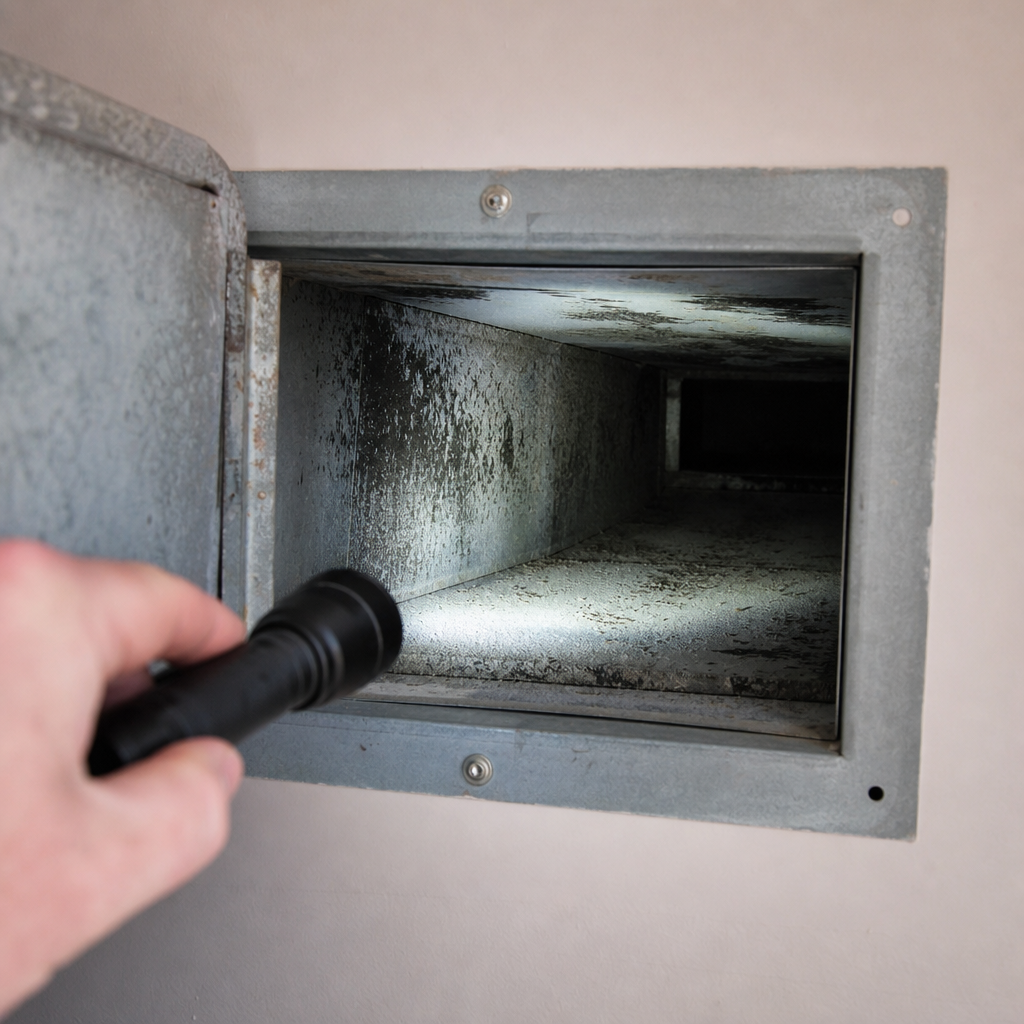
Supply and return ducts act as the primary highway for distributing conditioned air, meaning any mold spores colonizing these pathways are quickly circulated into every room of your home. When organic dust accumulates inside your ductwork, it serves as an abundant food source for mold the moment local Pacific Northwest humidity is introduced.
Symptoms of Duct Contamination
Identifying contamination early prevents widespread indoor air quality issues. Homeowners should watch for these common signs:
- A persistent, musty odor that intensifies whenever the heating or cooling system cycles on.
- Visible black, green, or grey speckled deposits clustering around the edges of supply registers and return grilles.
- Unexplained, worsening allergy symptoms or respiratory irritation while indoors.
To address these issues, physical cleaning with a specialized rotating brush tool is part of mechanical debris removal, but true mold remediation requires negative pressure containment, HEPA filtration, and EPA-registered treatments on hard surfaces only. For extreme home contamination, costs can escalate. Comprehensive HVAC mold remediation costs range from $3,000 to $10,000 for severe, systemic issues (with some projects ranging from $2,000 to $6,000), though timely maintenance prevents these extremes. We offer free, no-obligation estimates and urgent air quality assessments to catch buildup before it requires industrial-scale commercial air duct cleaning.
Repair vs. Replace for Flex Ducts
When dealing with contaminated ductwork, the type of duct material dictates whether you can clean the system or if you must replace it entirely.
| Duct Type | Cleaning Approach | Recommendation for Severe Mold |
|---|---|---|
| Metal Ducts | Resilient to mechanical agitation; can be thoroughly swept with a rotating brush and sanitized. | Repair/Clean: Metal surfaces can be restored to pristine condition. |
| Flexible (Flex) Ducts | Mylar lining is fragile; aggressive brushing can tear the inner core, and mold roots deeply into insulated jackets. | Replace: If mold penetrates the porous fiberglass insulation, complete replacement is the safest option. |
For homeowners facing sudden indoor air quality issues, securing professional services or scheduling urgent mold remediation for ducts is vital. We are ready to assist with detailed system inspections to ensure your ventilation system is clean and clear of debris.
5. Evaporator Coils and Condensate Pans: The Moisture Source
Evaporator coils and condensate pans are the primary moisture sources in your HVAC system, constantly generating water during the cooling cycle that can trigger mold growth if not properly managed. While the average cost of professional black mold removal for general household surfaces is around $2,400, HVAC-specific remediation costs typically range from $3,000 to $10,000, or between $2,000 and $6,000 depending on the scope of work. Keeping these specific components dry and clean is the most effective way to prevent costly systemic contamination.
Why Evaporator Coils Are Mold Hotspots
During summer, evaporator coils extract heat and humidity from your indoor air, causing water to pool continuously on the metal surfaces. When dust bypasses your air filter, it sticks to these wet coils, creating a perfect breeding ground for spores. Dirty coils also restrict airflow, compounding local humidity issues inside the ductwork and forcing the system to run longer, which accelerates the condensation cycle.
EPA-Registered Products for Hard Surfaces
To safely manage mold on non-porous system components, technicians follow a strict protocol:
- Physical Debris Removal: Technicians use specialized tools to dislodge impacted dust from the coil fins.
- Targeted Application: Only EPA-registered products are applied to hard, non-duct surfaces like the metal condensate pan.
- System Flushing: The drain line is cleared to ensure standing water flows out of the home immediately.
For homeowners facing sudden system failures or musty odors, securing emergency air duct cleaning services ensures these moisture pans are cleared before spores migrate. While complex remediation addresses active biological growth, our team provides the essential mechanical cleaning and rotating brush technology needed to keep coils free of the organic debris that feeds mold. Whether you need residential upkeep or commercial air duct cleaning, addressing this moisture source is critical.
6. How to Choose a Trusted Local HVAC Cleaning Company
To choose a trusted local HVAC cleaning company, you must verify their active licensing, ensure they carry robust liability insurance, and confirm they use physical agitation tools rather than simple vacuums. Selecting a credentialed, community-focused specialist protects your property and guarantees that the physical source of your indoor air quality issues is actually removed.
Licensing, Insurance, and Risk Aversion
Working with a fully licensed and insured contractor is non-negotiable when dealing with delicate ventilation systems. Proper mechanical cleaning requires specialized training to avoid damaging flexible ductwork or spreading loose debris. Homeowners facing urgent mold remediation for ducts should always verify these credentials upfront. Our team manages this risk by employing fully licensed and insured professionals, such as the technicians at Meridian Air Duct Cleaning Service Vancouver, who protect your home during every phase of the cleaning process.
The Danger of National Chains and Bait-and-Switch Pricing
National cleaning chains often outsource their commercial air duct cleaning and residential jobs to unvetted subcontractors who rely on superficial vacuuming. These generic providers frequently miss the localized condensation issues unique to Pacific Northwest crawl spaces, leading to rapid regrowth. Instead of risking bait-and-switch pricing, look for local experts with a flawless reputation. We focus on transparent communication, utilizing advanced rotating brush tools to thoroughly clear your system.
7. Frequently Asked Questions About HVAC Mold
Addressing ventilation moisture promptly prevents spores from spreading throughout your Pacific Northwest home. When dealing with musty odors or damp crawl spaces, homeowners need quick, reliable answers to protect their indoor air quality.
How quickly can I get my ducts inspected and cleaned?
For urgent mold concerns, an emergency inspection and system shutdown can be initiated within 24 hours, while full remediation typically takes 2 to 5 days. Because high humidity accelerates spore growth, rapid response times are critical. Regular inspections help catch moisture issues before they require extensive remediation services.
What is the difference between residential and commercial air duct cleaning?
While residential services focus on localized home moisture traps, commercial air duct cleaning manages larger volume systems with complex zoning. Both require specialized physical agitation to be effective. For those experiencing sudden indoor air quality issues, securing emergency air duct cleaning services ensures that licensed professionals can immediately assess and clear the system.
_
Sources
- 2023 AHS Infographic: Housing Quality – census.gov (2023)
- NIOSH Dampness and Mold Assessment Tool (DMAT): Documentation and Data Analysis of Dampness and Mold-Related Damage in Buildings and Its Application – pmc.ncbi.nlm.nih.gov (2019)
- Cityscape: A Journal of Policy Development and Research – Regulatory Reform and Affordable Housing – Data Shop: Musty Smells, Mold, and Moisture in the U.S. Housing Stock: Results from Two National Surveys – huduser.gov (2015)
- Health effects associated with dampness and mould – ncbi.nlm.nih.gov (2007)
Related reading: Mold in Air Ducts – Call Now-10% Off – Same-Day Service – Free Estimate
Frequently Asked Questions
What specific steps should I take immediately if I suspect mold is growing inside my HVAC system?
If you suspect mold, the U.S. EPA advises turning off your HVAC system immediately to prevent spores from circulating throughout your home. You should then contact a professional to schedule a system inspection. Meridian Air Duct Cleaning Service can perform a thorough mechanical duct cleaning to eliminate the organic debris that feeds mold and help prevent future regrowth.
Can moldy flexible ductwork be salvaged, or must it always be replaced?
Unlike rigid metal ducts that can be mechanically swept and sanitized, flexible ducts with severe mold must be replaced because their fragile Mylar lining tears easily and mold roots deeply into the porous fiberglass insulation. If you are unsure about your system's condition, Meridian Air Duct Cleaning Service offers a free, no-obligation ductwork inspection to assess whether your flex ducts require replacement or if a mechanical cleaning is sufficient.
How does the local Pacific Northwest climate specifically contribute to HVAC mold growth?
The Pacific Northwest's damp climate creates a stark temperature differential when cold crawl space air clashes with warm duct interiors, forming a hidden condensation trap on metal ductwork. This localized moisture quickly activates dormant mold spores on uncleaned surfaces. To combat this, Meridian Air Duct Cleaning Service provides specialized mechanical cleaning and system maintenance to keep your ventilation clear of moisture-trapping debris.
About the author
 |
Sarah Jenkins Sarah is an HVAC professional with over 8 years of experience in residential and commercial indoor air quality. She holds a degree in Environmental Science from Washington State University and is certified by the National Air Duct Cleaners Association (NADCA). Her expertise focuses on educating the Vancouver community about efficient HVAC maintenance and effective contaminant removal strategies. |
Dusty vents or weak airflow at home?
We’re available now — call for a fast, free estimate.
Call Now - Free Estimate