
Quick Summary
Suspected fungal growth and musty odors in your HVAC system require professional meridian air duct cleaning mold removal to eliminate airborne health hazards at their source rather than relying on ineffective chemical fogging sprays. As a trusted local specialist, Meridian Air Duct Cleaning Service Vancouver explains that true remediation requires identifying moisture sources, washing hard duct surfaces, and replacing contaminated porous insulation under EPA guidelines. Readers will understand how to recognize hidden HVAC contamination, evaluate honest pricing factors, and call (833) 637-3677 to schedule a same-day inspection with a free estimate.
Air Duct Cleaning and Mold Remediation
Finding mold inside your heating and cooling system is stressful, especially when musty smells blow through your vents when the system runs. If you are dealing with suspected fungal growth in your ventilation system, air duct mold remediation focuses on finding and fixing the moisture source, cleaning visible mold on hard duct surfaces, and removing contaminated materials. Rather than masking musty odors with temporary sprays, proper remediation, as recommended by Meridian Air Duct Cleaning Service Vancouver, addresses the moisture problem that allowed mold to grow.[3]
The Environmental Protection Agency (EPA) notes that routine duct cleaning is not always necessary, but cleaning is recommended when there is visible mold growth inside hard-surface ducts or on other mechanical components of your HVAC system. Uninsulated spaces and high humidity can cause condensation on metal ductwork, making proper inspection and remediation essential for maintaining indoor air quality.[4] See also Same-Day Air Duct Cleaning Service in Vancouver | 10% Off & Free Estimate | Same-Day Service.
What Is Involved in Professional Air Duct Mold Remediation?
Air duct mold remediation requires addressing moisture issues and properly cleaning or replacing affected components rather than simply applying temporary sprays or biocides.
Effective mold remediation in duct systems focuses on several key steps:
- Moisture Source Correction: According to the EPA, mold control requires moisture control. Water-damaged areas and wet materials should be dried within 24 to 48 hours to prevent mold growth. Moisture issues such as duct air leaks, poor insulation, or clogged condensate drain lines must be fixed.
- Cleaning Visible Mold on Hard Surfaces: Visible mold on hard-surface ducts and mechanical components can be cleaned using water and detergent.
- Porous Material Replacement: Under EPA guidelines, wet or moldy porous materials, such as fiberglass duct liner or duct board, cannot be effectively cleaned and must be removed and replaced.
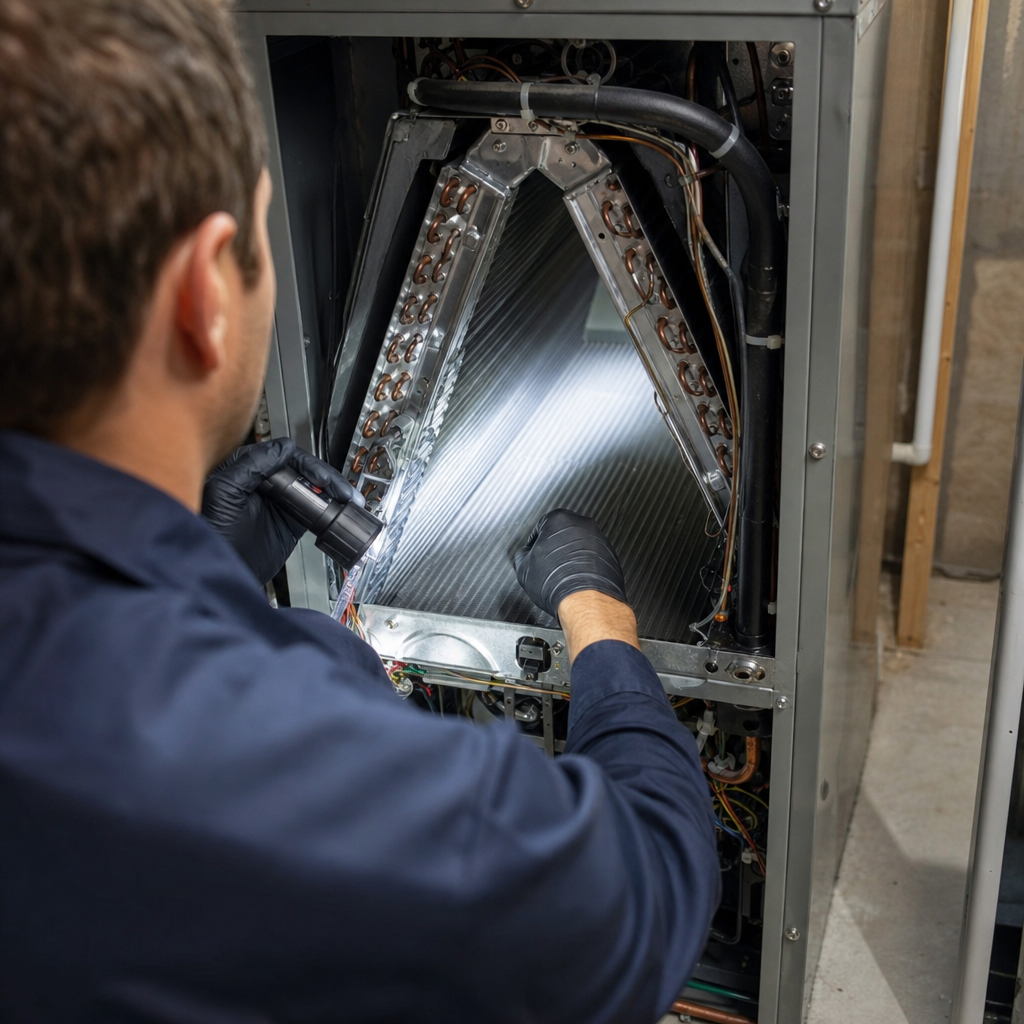
- Component Maintenance: Technicians inspect and clean accessible HVAC components, including the evaporator coil and drain pan, where condensation and standing water can accumulate.
The Centers for Disease Control and Prevention (CDC) states that mold exposure can cause symptoms such as nasal stuffiness, eye irritation, wheezing, or skin irritation. It can also cause coughing and worsened asthma symptoms in susceptible individuals, such as people with asthma or mold allergies.[1]
How Much Does Professional Air Duct Mold Removal Cost?
Pricing for air duct mold remediation depends on several practical factors: the overall square footage of the property, the number of supply and return vents, system accessibility (attic vs. crawlspace vs. basement), and whether internal fiberglass insulation has been compromised and requires replacement.
A basic cleaning on an uncontaminated system is typically straightforward, but as Meridian Air Duct Cleaning Service Vancouver points out, mold remediation requires addressing moisture sources, cleaning hard surfaces with water and detergent, and replacing contaminated porous materials. Beware of contractors advertising unrealistically cheap whole-house specials ($49 to $99); these teaser rates often lead to aggressive upselling or superficial work that leaves active contamination untouched.
| Service Feature | Low-Cost Teaser Cleaners | Chemical Fogging Only | Comprehensive Source Remediation |
|---|---|---|---|
| Pricing Transparency | Hidden add-on fees on arrival | Flat fee for chemical spray | Clear upfront estimate based on system size |
| Surface Cleaning | Light wand dusting or basic vacuum | None (spray misted into vents) | Washing hard surfaces with water and detergent |
| Contaminated Materials | Ignored | Sprayed over | Removal and replacement of wet or moldy fiberglass insulation |
| Moisture Assessment | Ignored | Ignored | Inspection of duct insulation, drain lines, and moisture sources |
Variables That Influence Your Final Quote
- Duct Material: Smooth sheet metal ducts can be cleaned with water and detergent. Flexible ducting or internally lined fiberglass duct board with mold contamination must be replaced.
- Accessibility: Ducts located in tight crawlspaces or attics require additional labor compared to easily accessible setups.
- Evaporator Coil and Drain Pan Condition: If mold or standing water is present in the drain pan or on coils, cleaning these components is necessary to prevent continued moisture and mold issues.
Why Biocide Fogging Fails to Solve Duct Mold Problems
Need meridian air duct cleaning mold removal?
We’re available now — call for a fast, free estimate.
Many homeowners are offered chemical fogging as a quick fix for duct mold. Fogging involves introducing an aerosolized chemical through the ductwork. While fogging might temporarily mask odors, it does not solve the underlying mold problem.
Here is why fogging alone falls short:
- Chemicals Do Not Eliminate the Source: Spraying a biocide or disinfectant does not remove dust, debris, or mold from surfaces.
- Moisture Issues Remain Unaddressed: If warm, humid air continues to encounter cold, uninsulated duct surfaces, condensation will continue to form. No chemical spray prevents mold from returning if moisture problems persist.
- Porous Materials Cannot Be Disinfected: EPA guidance indicates that moldy porous insulation cannot be salvaged with chemical sprays and must be replaced.
As Meridian Air Duct Cleaning Service Vancouver explains, remediation requires cleaning visible mold on hard surfaces, removing contaminated porous materials, and fixing moisture sources to keep materials dry.
Warning Signs of Mold Inside Your Air Ducts
Because most ductwork is hidden behind drywall, under subfloors, or in attics, biological growth often develops unnoticed. Watch for these common indicators:
1. Musty or Earthy Odors When the System Starts
If you notice a distinct damp or musty smell when the heating or cooling system turns on, mold growth may be present inside the duct system or air handler.
2. Visible Dark Specks Around Vent Grilles
Inspect the registers, particularly in high-humidity areas like bathrooms, kitchens, and basements. Visible dark spotting or growth around grilles can indicate condensation and mold growth.
3. Standing Water in the Condensate Drain Pan
Air conditioning and heat pump systems produce moisture during cooling cycles. If the condensate drain line is clogged, standing water in the drain pan can lead to mold growth near the blower fan.
4. Respiratory Irritation or Allergy Symptoms Indoors
Occupants may experience respiratory irritation, coughing, wheezing, or aggravated asthma symptoms indoors when mold is present in the HVAC system.
Frequently Asked Questions
How do professionals remove mold from HVAC air ducts?
Professionals inspect the system to identify moisture sources, clean visible mold from hard duct surfaces and mechanical components using water and detergent, and remove and replace wet or moldy fiberglass duct liner or duct board.
Does standard duct cleaning get rid of mold completely?
Standard dusting does not resolve mold problems if moisture is still present. Successful remediation requires cleaning visible mold on hard surfaces, replacing contaminated porous materials, and correcting moisture and condensation issues.
Is mold in air vents dangerous?
According to the CDC, mold exposure can cause respiratory irritation, coughing, wheezing, and worsened asthma symptoms, especially in susceptible individuals such as people with asthma, allergies, or weakened immune systems.[2]
How can homeowners prevent mold from returning to ductwork?
To prevent mold growth, keep indoor humidity levels between 30% and 50%, dry any wet materials within 24 to 48 hours, ensure ductwork in unconditioned spaces is properly insulated, and keep condensate drain lines clear and functioning properly.[5]
How should you schedule an HVAC duct inspection?
If you suspect mold in your duct system, contact a qualified HVAC or duct remediation professional like Meridian Air Duct Cleaning Service Vancouver to perform an inspection, identify any moisture sources, and evaluate whether cleaning or material replacement is required.
Need meridian air duct cleaning mold removal?
We’re available now — call for a fast, free estimate.
Sources
- Diagnosis Codes for Mold Infections and Mold Exposure Before and After Hurricane Harvey Among a Commercially Insured Population—Houston, Texas, 2016–2018 – stacks.cdc.gov (2018)
- A Spreading Concern: Inhalational Health Effects of Mold – PMC – pmc.ncbi.nlm.nih.gov (2007)
- [PDF] Should You Have the Air Ducts in Your Home Cleaned? – EPA – epa.gov
- Should You Have the Air Ducts in Your Home Cleaned? | US EPA – epa.gov
- A Brief Guide to Mold, Moisture and Your Home | US EPA – epa.gov
Related reading: Emergency Duct Mold Removal Vancouver – Call Now-10% Off – On-Site in 60 Minutes – Free Estimate
Related reading: Meridian Air Duct Cleaning Service Vancouver Rates – 10% Off & Free Estimate – Same-Day Service
Related reading: Residential Duct Cleaning Cost Vancouver – Call Now-10% Off – Same-Day Service – Free Estimate
Frequently Asked Questions
Can mold in flexible ductwork or fiberglass duct boards be cleaned without replacement?
No, porous materials like fiberglass duct board and flexible ducting cannot be effectively scrubbed or sanitized once mold penetrates the fibers. Meridian Air Duct Cleaning Service Vancouver follows strict EPA protocols by removing and replacing these contaminated porous materials while thoroughly washing hard sheet metal surfaces with detergent.
How quickly can I get an air duct mold inspection and estimate?
Homeowners dealing with musty odors or visible spores can call (833) 637-3677 to schedule a same-day visit. Meridian Air Duct Cleaning Service Vancouver provides rapid on-site inspections and delivers a free, no-obligation estimate tailored to your HVAC system layout and duct condition.
How long does a full meridian air duct cleaning mold removal service take?
A comprehensive mold remediation typically takes 3 to 5 hours depending on square footage, duct accessibility, and whether damaged insulation needs replacement. Meridian Air Duct Cleaning Service Vancouver performs complete source removal, component washing, and moisture checks before clearing your HVAC system for safe operation.
About the author
 |
Sarah Jenkins Sarah is an HVAC professional with over 8 years of experience in residential and commercial indoor air quality. She holds a degree in Environmental Science from Washington State University and is certified by the National Air Duct Cleaners Association (NADCA). Her expertise focuses on educating the Vancouver community about efficient HVAC maintenance and effective contaminant removal strategies. |
Dusty vents or weak airflow at home?
We’re available now — call for a fast, free estimate.
Call Now - Free Estimate