
Quick Summary
When mold in air ducts threatens your indoor air quality, superficial DIY sprays and generic cleaning vacuums are insufficient because they leave the root colonies intact. To safely eliminate these biological hazards, Meridian provides specialized local remediation in Vancouver and Portland using professional-grade rotating brush tools to physically dislodge stubborn contaminants under continuous negative pressure. By calling (833) 637-3677, homeowners can schedule a free, no-obligation estimate, secure a 10% customer discount, and permanently resolve the localized condensation traps fueling mold growth.
Mold in Air Ducts – Fast, Safe Removal in Vancouver & Portland
If you suspect mold in air ducts, Meridian Air Duct Cleaning can safely eliminate the contamination today. While many homeowners assume a quick spray of disinfectant or a DIY wipe-down will solve the problem, the reality is that superficial cleaning actually worsens indoor air quality by dispersing active spores into your breathing zone. True remediation requires physical agitation to break the mold’s structural bond with your duct walls.
As HVAC professionals, we have seen how generic national cleaning chains and general handymen try to tackle this issue with standard shop vacuums, only to leave the root colony intact. At Meridian Air Duct Cleaning, we use specialized rotating brush tools to physically dislodge stubborn contaminants, backed by the security of licensed and insured professionals who protect your property throughout the process. Do not risk your family’s health with half-measures. Call (833) 637-3677 to schedule a free, no-obligation estimate.
Step 1: Identify the Signs of Mold in Air Ducts
Step 1: Identify the Signs of Mold in Air Ducts in brief: You can identify mold in air ducts by a persistent musty odor when your HVAC system runs, visible black or green splotches around air vents, and unexplained allergy symptoms like coughing or sneezing. If you suspect mold, professional air duct inspection is recommended to confirm its presence and prevent further spreading.
Identifying mold early prevents localized spores from contaminating your entire home. In the Pacific Northwest, high indoor relative humidity often accelerates this growth, turning minor condensation into a systemic issue. This is especially true in unconditioned attics and crawlspaces where warm, humid air meets cold ductwork, creating a localized condensation trap. According to a press release by Green Fox Air Quality, nearly 50% of inspected duct systems showed evidence of mold, moisture issues, or leaks. When moisture pools in these uninsulated areas, it creates a breeding ground that generic cleaning services often overlook.[3]
What Does Mold in Air Ducts Look Like?
While you cannot see deep inside your ventilation system without specialized cameras, you can spot the warning signs around your registers. Look for these visual indicators during your inspection:
- Visible Growth: Black, green, or white fuzzy patches forming on or directly behind your supply grilles.
- Powdery Residue: A gray or off-white dust-like substance that clings to the vent slats and does not brush off easily.
- Damp Insulation: Wet spots or dark discoloration on the external insulation wrapping your ductwork, indicating a compromised vapor barrier.
If you notice these signs, scheduling professional vent cleaning services is the safest next step. The Environmental Protection Agency (EPA) recommends professional remediation for any significant mold contamination in ductwork. Attempting to scrub these deposits yourself often releases millions of spores into your breathing zone.
Common Mold in Air Vents Symptoms
Because indoor air pollutants from mold in HVAC ducts can be 2 to 5 times higher than outdoor levels (according to data from Affordable Air), your physical health is often the first indicator of a problem. Mold exposure can trigger allergy symptoms, asthma flare-ups, and respiratory irritation, especially in people with existing respiratory conditions (according to COIT).
Homeowners often report a distinctive, earthy, or musty odor that intensifies the moment the heating or cooling system turns on. If family members experience unexplained coughing, watery eyes, or headaches that improve when they leave the house, the ductwork may be circulating active spores. Utilizing residential air duct cleaning from a specialized provider ensures the physical removal of these biological contaminants. For comprehensive property protection, Meridian Air Duct Cleaning Service Vancouver offers free, no-obligation estimates to assess your system and confirm whether professional duct cleaning services are required to restore your indoor air quality.
Step 2: Understand the Health Risks and System Impact
Mold in air ducts compromises indoor air quality by continuously circulating harmful spores, which can elevate indoor pollutant levels to two to five times higher than outdoor concentrations. This constant exposure poses serious respiratory risks for occupants while simultaneously degrading the mechanical efficiency of your HVAC system. Addressing this hidden hazard promptly is essential for maintaining both household health and system longevity.
Can Mold in Air Ducts Make You Sick?
Inhaling airborne spores can trigger immediate allergy symptoms, asthma flare-ups, and severe respiratory irritation, particularly in sensitive individuals. According to a press release by Green Fox Air Quality, approximately 60% of homeowners were unaware of mold, moisture, or leak problems in their duct systems. Over time, this lack of awareness can lead to severe health consequences. Affordable Air reports that long-term exposure to contaminated ductwork can cause permanent lung damage and serious conditions like hypersensitivity pneumonitis if left untreated. Utilizing professional vent cleaning services ensures these biological hazards are safely eliminated from your breathing zone.[4]
Impact on HVAC Blower and Evaporator Coils
Beyond health risks, mold accumulation directly threatens your heating and cooling infrastructure. When spores settle on damp evaporator coils and blower motors, they form a thick, insulating grime layer that restricts airflow and forces the system to run longer. This strain is often worsened in the Pacific Northwest, where localized condensation traps (caused by poor insulation in unconditioned attics and crawlspaces) create cold spots that accelerate moisture buildup.
To illustrate the danger of hidden moisture, consider a recent case study from Blue Ridge Heating & Air. A homeowner participating in a pilot program for AirGuard sensors detected hidden mold activity in their living room flex ducts. Blue Ridge Heating & Air responded, visually confirmed mold in the crawlspace, verified the threat with third-party testing, replaced the contaminated flex ducts, and treated the metal ductwork. This targeted intervention successfully reduced mold levels, leaving the AirGuard sensor in place to monitor the environment.
To safely restore your indoor climate, Meridian Air Duct Cleaning provides comprehensive residential air duct cleaning. Our licensed and insured technicians utilize professional-grade rotating brush tools to physically dislodge stubborn buildup from blower motors and coils, rather than relying on superficial DIY sprays.
Step 3: Diagnose the Root Cause (The Localized Condensation Trap)
Diagnosing the root cause of mold in air ducts requires identifying where moisture meets cold metal, creating a localized condensation trap. Simply cleaning the mold will not solve the issue if localized relative humidity remains above 50% inside your ventilation system. To permanently resolve this, homeowners must address the underlying thermal and moisture imbalances within their ductwork.
Why Mold Grows in Pacific Northwest Ductwork
In the damp climate of Vancouver and the wider Pacific Northwest, temperature differentials turn metal ducts into condensation factories. According to a press release by Green Fox Air Quality, about 25% of duct systems had leaking connections or sagging ductwork. These gaps allow moist, unconditioned air to seep into the system. According to COIT, the most effective solution for preventing mold in ducts is controlling moisture by fixing leaks and maintaining humidity below 50%. When national cleaning chains overlook these regional moisture dynamics, the mold inevitably returns.[5]
The Attic and Crawlspace Insulation Problem
The localized condensation trap typically occurs in unconditioned attics and crawlspaces where warm, humid air collides with poorly insulated metal plenums or sagging flex ducts. Meridian Air Duct Cleaning Service Vancouver addresses this local vulnerability directly. Unlike general HVAC companies or generic ventilation cleaning services, Meridian utilizes advanced rotating brush tools to physically dislodge stubborn contaminants while identifying the structural insulation failures causing the moisture. For long-term protection, choosing specialized professional duct cleaning services ensures that both the biological growth and the physical duct defects are resolved.
Step 4: Prepare the Workspace and Protect Your Property
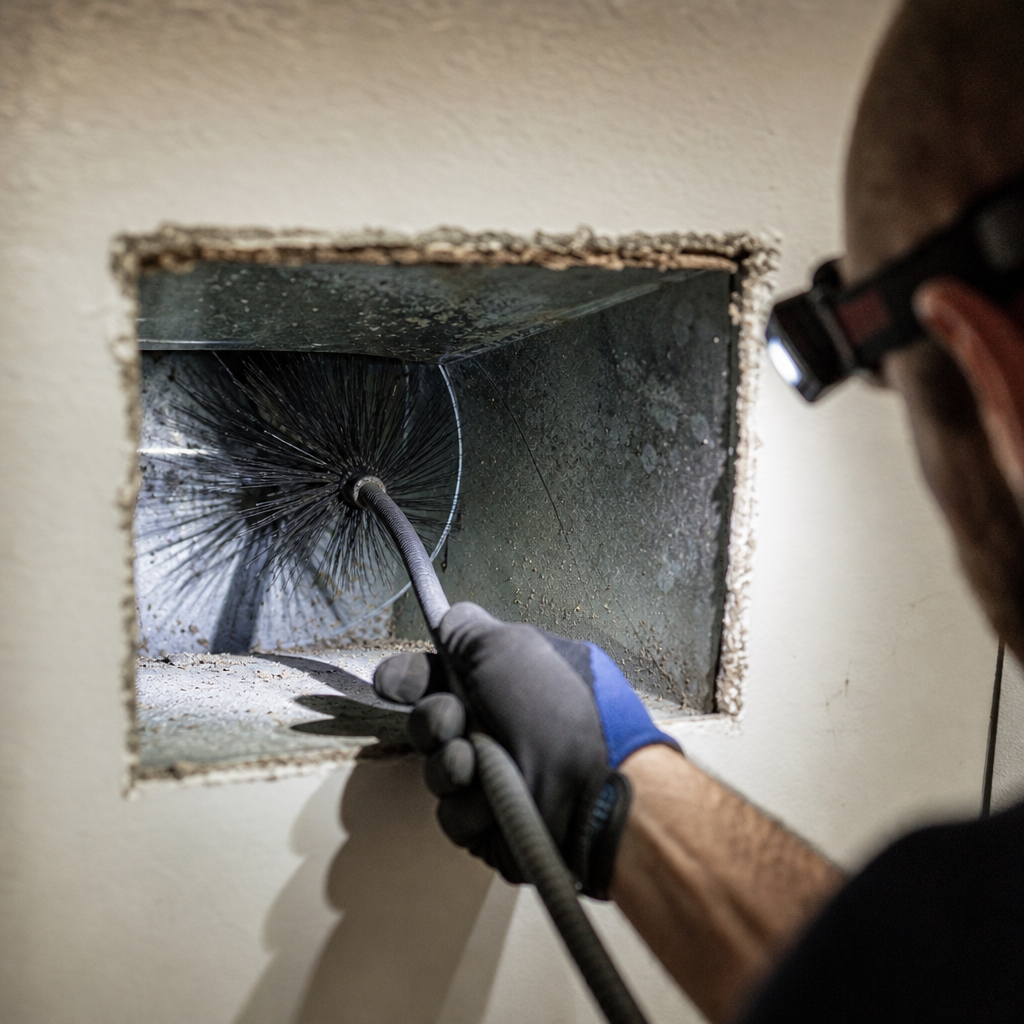
Preparing the workspace before mold removal ensures that disturbed spores do not escape into your living areas. Professional containment isolates the HVAC system, creating a sealed environment that prevents cross-contamination throughout your home.
What You’ll Need for Professional Containment
To stop spores from spreading, professional duct cleaning services employ specialized containment protocols:
- Seal all supply and return registers with heavy-duty plastic sheeting.
- Establish negative air pressure using HEPA-filtered vacuum systems.
- Isolate the target zone where attic condensation traps have fueled mold growth.
According to a press release by Green Fox Air Quality, approximately one-third of duct systems had indoor humidity levels exceeding the 60% EPA threshold for mold growth, making containment critical.[1]
Protecting Living Areas from Spore Release
DIY attempts often backfire because standard household vacuums lack true HEPA filtration, acting as spore-dispersal machines. Unlike generic providers, Meridian Air Duct Cleaning ensures safety through professional vent cleaning services that utilize negative pressure.
Step 5: Agitate and Extract Contaminants Professionally
Professional mold extraction requires physically dislodging deep-seated spores from the inner walls of your ventilation system and vacuuming them out using specialized negative pressure. Simply wiping down surface vents is insufficient because it leaves hidden colonies untouched inside the dark, damp runs of your ductwork.
The Power of the Rotating Brush Tool
To safely eliminate stubborn mold, Meridian Air Duct Cleaning Service Vancouver utilizes advanced rotating brush tools to scrub the interior metal surfaces. Unlike some national chains that may rely on basic vacuums, these specialized agitation tools physically break the bond between the mold and the duct walls. This mechanical agitation is vital for removing aggressive spores. In a 2025 San Antonio study, aggressive mold species like Chaetomium and Stachybotrys were identified in 30% of contaminated HVAC systems, emphasizing the need for rigorous physical removal rather than superficial cleaning.[2]
Cleaning Supply Ducts, Return Ducts, and Registers
A comprehensive remediation process must target every component of the system to prevent cross-contamination:
- Supply Ducts: Technicians run the rotating brush through each branch line to clear localized mold fed by the Pacific Northwest’s localized condensation traps.
- Return Ducts: Large return lines are thoroughly agitated to remove accumulated organic dust that feeds mold growth.
- Registers and Grilles: Rather than performing a basic wipe-down, professional vent cleaning services remove, wash, and sanitize these fixtures.
By investing in professional duct cleaning services instead of basic HVAC generalists, you ensure that residential air duct cleaning is performed safely under continuous HEPA-filtered negative pressure.
Step 6: Sanitize the Ductwork and Control Moisture
Sanitizing your ductwork and controlling indoor moisture is the final, critical step to guarantee mold does not return to your ventilation system. While physical extraction removes the bulk of the contamination, applying targeted sanitizers and lowering humidity eliminates remaining microscopic spores and deprives them of the moisture they need to regrow. According to the San Antonio Metropolitan Health District, in a 2025 study of San Antonio homes, indoor mold spore counts in untreated homes averaged 2,500 per cubic meter, triple the levels from 2020 (2025), underscoring the necessity of thorough post-cleaning treatment.
Applying EPA-Approved Sanitizers
Once the rotating brushes from professional vent cleaning services have cleared the physical debris, technicians apply EPA-registered, HVAC-safe antimicrobial coatings. These specialized sanitizers are fogged through the entire system to neutralize any lingering microscopic spores without damaging your duct liner or metal surfaces. Unlike some national chains that may rely on basic vacuums, professional duct cleaning services ensure the formula coats every bend, followed by running the system’s fan to dry the ductwork completely.
Maintaining Indoor Humidity Below 50%
To prevent the Pacific Northwest’s damp air from feeding new mold colonies in your crawlspaces and attic duct runs, you must manage your home’s microclimate. Homeowners can maintain a dry, inhospitable environment for mold by following three key steps:
- Deploy Dehumidifiers: Place dedicated dehumidifiers in high-moisture zones like basements or crawlspaces to keep relative humidity consistently below 50%.
- Utilize Active Ventilation: Always run bathroom and kitchen exhaust fans during and after cooking or showering to vent humid air outside.
- Schedule Residential Air Duct Cleaning: Partner with a local specialist like Meridian Air Duct Cleaning to seal duct leaks and ensure proper insulation, eliminating the cold-metal condensation traps where mold thrives.
What Does Mold Remediation Cost in Air Ducts?
Professional mold remediation and residential air duct cleaning pricing varies depending on the overall size of your HVAC system, duct accessibility, and the severity of the mold contamination; exact costs vary based on system size and mold severity; contact Meridian for a free, no-obligation estimate. While some general handymen offer cheap surface wipes, permanently resolving a mold issue requires specialized equipment to address the underlying moisture problems.
According to the San Antonio Metropolitan Health District (2025), residents with contaminated ducts showed a 23% faster memory decline and a 31% increased risk of respiratory infections (2025). This medical reality highlights why property owners must invest in complete physical extraction rather than superficial sprays. In the Pacific Northwest, mold often stems from a localized condensation trap caused by poor insulation in unconditioned crawlspaces and attics, rather than dirty vents alone.
To help you evaluate your options, the table below compares different service approaches for resolving ventilation moisture and mold issues:
| Feature/Capability | National Cleaning Chains | General HVAC Contractors | Meridian Air Duct Cleaning |
|---|---|---|---|
| Rotating Brush Technology | ✗ | Variable | ✓ |
| Condensation Trap Diagnosis | ✗ | ✓ | ✓ |
| Upfront, No-Hidden-Fee Pricing | ✗ | ✗ | ✓ |
| Licensed & Insured Specialists | ✓ | ✓ | ✓ |
To ensure transparent pricing for residential and commercial property owners, Meridian Air Duct Cleaning Service Vancouver provides upfront pricing with free, no-obligation estimates and zero hidden fees. Call (833) 637-3677 to schedule your professional vent cleaning services and secure a healthier indoor environment.
Frequently Asked Questions About Mold in Air Vents
Addressing mold in your HVAC system requires clear, actionable answers to ensure your home remains safe and efficient. According to verified sources such as COIT, Affordable Air, and the CDC, indoor mold growth can trigger respiratory symptoms and worsen asthma in sensitive individuals. Here are the answers to the most common questions about managing this issue in the Pacific Northwest.
Can I clean mold out of air ducts myself?
No, DIY cleaning is not recommended for mold. Standard household vacuums and topical sprays cannot reach deep inside the ventilation system, and attempting to scrub the metal can release millions of spores into your living spaces. Safe extraction requires professional duct cleaning services equipped with high-powered negative pressure vacuums and specialized rotating brush tools to physically dislodge the spores without contaminating your home.
How much does residential air duct cleaning cost in Vancouver, WA?
For a standard home, professional vent cleaning services and mold remediation pricing varies depending on the size of your HVAC system, the accessibility of the ductwork, and whether the mold has spread to the main air handler; exact costs vary based on system size and mold severity; contact Meridian for a free, no-obligation estimate. Meridian Air Duct Cleaning provides free, no-obligation estimates to give you an accurate, upfront price before any work begins.
How fast can you resolve a mold issue in my home or business?
Urgent indoor air quality concerns require rapid action to address contamination before it spreads. Most residential air duct cleaning jobs are completed in three to five hours. Technicians will isolate the workspace, extract the contaminants, and sanitize the system so you can breathe clean air again by the end of the day.
Are your ventilation cleaning services licensed and insured?
Yes, all services are fully licensed, bonded, and insured for both residential and commercial properties. Working with certified professionals protects your property and ensures that all remediation work complies with local safety standards. To schedule your service or request a free estimate, call Meridian Air Duct Cleaning at (833) 637-3677.
Sources
- NIOSH Health Hazard Evaluation Report 2022-0077-3422 – cdc.gov (2022)
- Mold contamination and air handling units – pubmed.ncbi.nlm.nih.gov (2007)
- Green Fox Air Quality Finds Mold, Moisture or Leaks in More Than Half of South Florida Duct Systems It Inspected This Summer – miamiherald.com (2026)
- Green Fox Air Quality Finds Mold, Moisture or Leaks in More Than Half of South Florida Duct Systems It Inspected This Summer – usatoday.com (2026)
- [PDF] Lawrence Berkeley National Laboratory – eScholarship.org – escholarship.org
Frequently Asked Questions
What specific sanitizing agents are used after the mold is physically removed from the ducts?
Once physical extraction is complete, Meridian applies EPA-registered, HVAC-safe antimicrobial coatings. These specialized sanitizers are fogged throughout the entire system to neutralize any lingering microscopic spores without damaging your duct liner or metal surfaces.
How do your technicians identify the structural issues causing the mold in my attic or crawlspace?
During our inspection, Meridian specialists look for localized condensation traps caused by poor insulation, sagging flex ducts, or leaking connections in unconditioned spaces. We diagnose these thermal and physical defects alongside the mold removal process to ensure the moisture source is permanently resolved.
Will my family or pets need to vacate the home during the mold remediation process?
No, vacating the home is generally not necessary because we establish strict containment protocols. Meridian isolates the work area, seals all supply and return registers with heavy-duty plastic, and uses continuous HEPA-filtered negative pressure to ensure zero mold spores escape into your living zones during cleaning.
About the author
 |
Sarah Jenkins Sarah is an HVAC professional with over 8 years of experience in residential and commercial indoor air quality. She holds a degree in Environmental Science from Washington State University and is certified by the National Air Duct Cleaners Association (NADCA). Her expertise focuses on educating the Vancouver community about efficient HVAC maintenance and effective contaminant removal strategies. |
Dusty vents or weak airflow at home?
We’re available now — call for a fast, free estimate.
Call Now - Free Estimate